Tutorial 3
Does quitting smoking cause weight gain?
This example is reproduced from Chapter 12 of Causal Inference: What If (the book), by Miguel Hernan. The book is a great and thorough course on Causal Inference, and highly recommended for those who want to get deeply into it.
This case study uses data from the National Health and Nutrition Examination Survey Data Epidemiologic Follow-up Study (NHEFS). It attempts to accurately quantify the effect of smoking cessation on weight gain. In short, do people gain weight after giving up smoking?
We can see that despite some simplifications to make this tutorial easy, we obtain a result close to the reported value given in the book.
Step 1: Get the data
Download tutorial-3-nhefs.csv, then upload it via the Data page.
Step 2: Create a new Study
- Click on Studies in the menu bar.
- Give the new Study any name you like (e.g. Tutorial 3).
- Select the Dataset you just uploaded, and press Create.
Step 3: Specify Treatment and Outcome
Select variable Quit Smoking? as the Treatment, and Change in Weight as the Outcome.
Causal Wizard automatically detects the data type of the Treatment column and adjusts the group editor to match. Since quit smoking is a boolean (True/False) column, click Treatment groups and confirm False is assigned to Control and True to Treated - this is the default.
Step 4: Draw Causal Diagram
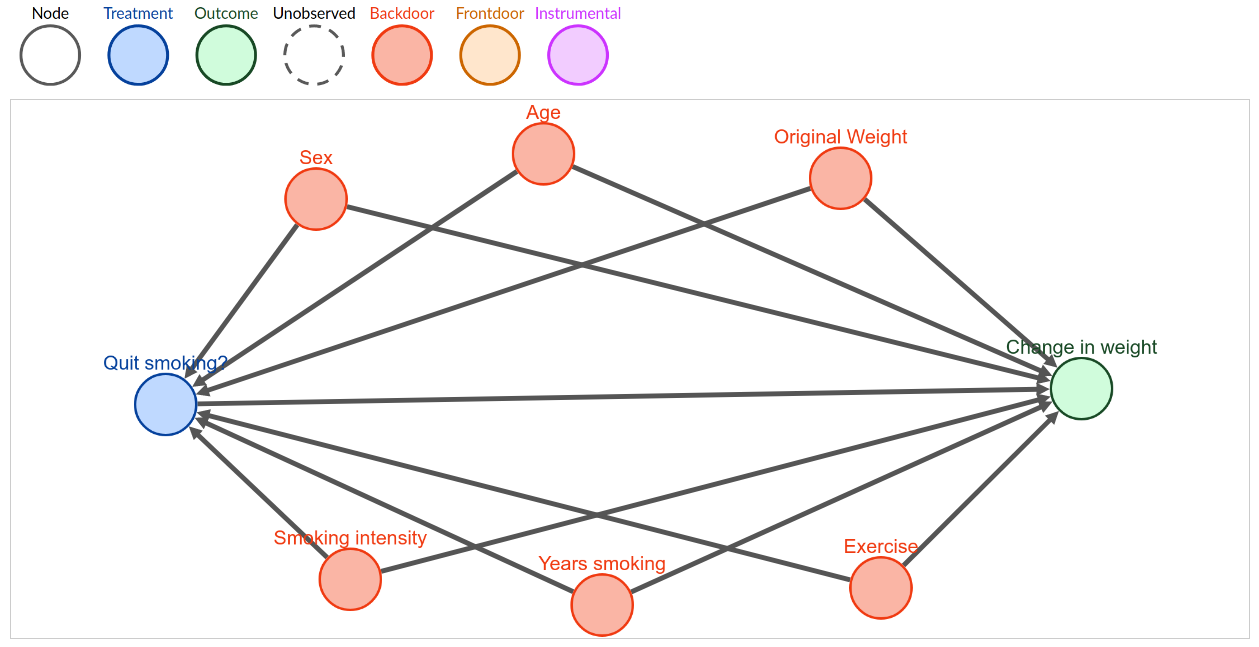
This case study uses all the numerical variables in the dataset. Create the graph as shown in the picture below (nodes are automatically coloured during the Check process; verify the colours match after checking, to confirm you've added all the same edges).
Basically, every variable is treated as a "confounder" - a cause of both Treatment and Outcome.
In addition, there's one edge directly from Treatment Quit Smoking? to Outcome Change in Weight.
Step 5: Check, download, and run the notebook
- Press Check.
- If everything went as planned, select "Backdoor: Propensity Score-based Inverse Weighting" as the Model - this is the estimator used in the original example in Miguel's book.
- Click Download config JSON.
- Open the notebooks (Open in Colab, or clone the repository) and run both notebooks top to bottom, providing your config file and data file when asked.
Step 6: Reviewing the results
In the Findings section, you should see something like:
- The Average Treatment Effect (ATE) of treatment Quit Smoking on outcome Change in Weight was estimated as approximately 3.05 (95% Confidence Interval roughly [2.11, 3.85]).
On Chapter 12, page 158 of "What If", an ATE of 3.4 kg is reported. This is well within the 95% confidence interval of our simplified model above (your exact numbers will vary slightly, since the notebook re-fits the model with a random held-out test split each run).
In the Refutation / validation section, you'll likely notice the placebo treatment test fails - perhaps due to dataset size and noise, but also perhaps due to simplified modelling. These validation tests are quite strict - note that the placebo treatment effect is much smaller than the real one, and quite close to zero even though not quite zero. Since this is a propensity-based estimator, you'll also see a Positivity check and Covariate balance (Love plot) section, worth reviewing to confirm the Treated and Control groups genuinely overlap.